



Removing water spots from car paint. The 72 hours after the May rain.
Four sunny days at 24 degrees Celsius. Then four rainy days with about 30 millimeters of rain in total, almost 14 millimeters of which fell today alone. A recurring question in our advice is: Does a spray sealant prevent water spots? The honest answer doesn't depend on the sealant, but on what you do with the paint in the next three days.
Water spots on car paint don't form during the rain itself, but on the first warm, sunny day afterward. If you read the weather forecast, you have a 72-hour window until Saturday to gently remove mineral residues before the sun bakes them into the clear coat finish.
Water spots on car paint — what happens after the May rain
The last eight days in Lower Saxony have been a lesson in paint care. From April 29th to May 2nd, the sun was over the garden with highs between 17 and 24 degrees Celsius. Pollen, Saharan dust, and brake dust settled on every car body, and no washing could remove it.
From May 3rd, the weather changed. 5.9 mm of rain on Sunday, 3.3 mm on Monday, 6.4 mm on Tuesday, and today the OpenWeatherMap forecast is for 13.9 mm at 7.5 degrees Celsius and continuous rain. In total, about 30 millimeters of precipitation in four days, plus 86 percent humidity and a strong westerly wind at 6 meters per second.
The problem is not the rain. The problem is that, according to the forecast, Saturday will bring 18 degrees Celsius and breaks in the clouds, and Sunday will be 19 degrees Celsius. This is exactly when the mineral-rich rainwater dries on a surface that has been exposed to pollen for the last four weeks. This sequence of weather is the classic spring water spot trigger in the North German Lowland.
A second factor aggravates the situation. The temperature dropped from 24 to 10.6 degrees Celsius within five days. Material science says that the paint contracts, the clear coat pores open again with the next warming, and everything that is on the surface during the cold phase gets trapped. If you simply let the car get wet now and do nothing, you'll have paint with deep-seated dirt next week.
How water spots form on the clear coat
Rainwater is not distilled. On its way to the car body, it picks up everything in the air: calcium, magnesium, sulfates, pollen grains, Saharan dust particles, and industrial aerosols. In Northern Germany, the hardness of precipitation is between 6 and 14 degrees of German hardness, depending on the direction of the weather front.
As long as the drops are liquid on the paint, it's harmless. A gentle wash is enough. But as soon as the sun evaporates the water, the dissolved minerals remain as a fine ring at the edge of each drop. The pollen film underneath is simultaneously activated by the UV heat.
Specifically: at surface temperatures of about 25 degrees Celsius and a pollen density like that which April has put on the car, an enzymatic reaction begins which microscopically etches the clear coat. In the workshop, this is later seen as dull shadow rings that no normal shampoo can remove. In detailing terminology, this effect is called etching; in German, it's called water spots or mineral etching.
The reaction happens faster than most people think. At 25 degrees Celsius paint temperature and direct sunlight, the first visible rings appear after 30 to 90 minutes. If you still think on Saturday morning that the car will simply dry off by itself, you'll already see the damage under the carport light on Saturday afternoon.
The insidious thing is: as long as the car body looks bone dry, nothing is noticeable. Only when a cloth is wiped over the surface or sunlight hits at a shallow angle do the shadow rings become visible. Then it's too late for a quick detailer; then you have to polish.
There are regional differences. In Lower Saxony and Schleswig-Holstein, the precipitation hardness is at the lower end of the scale at 6 to 9 degrees of German hardness because the west wind brings the water directly from the Atlantic. In Southern Germany and the Rhineland, the value rises to 12 to 14 degrees, where water spots after rain are correspondingly tougher. If you leave your car in the sun after a highway drive through several weather zones, you mix hardness levels on one car body and get water spots of varying intensity.
The right workflow between rain and sun window
If you want to keep your car clean over the weekend, you have three stages ahead of you. Today, Wednesday, and tomorrow, Thursday, are the calm preparation days, Friday evening to Saturday morning is the action window, and from Saturday afternoon, the sun works against any negligence.
Stage one is a touchless pre-wash as soon as the rain subsides. A high-foaming, pH-neutral snow foam like the Koch-Chemie Gentle Snow Foam GSF binds pollen and mineral film without dissolving coating or wax. Four to six minutes of dwell time are sufficient, then rinse with a soft stream.
Stage two is the gentle main wash with the two-bucket method and a pH-neutral shampoo. Here, the focus is not on shine, but on ensuring that the dirt particles bound by rain are removed from the paint in a controlled manner without scratching it. If you combine snow foam and main wash, you'll need about 45 minutes of work.
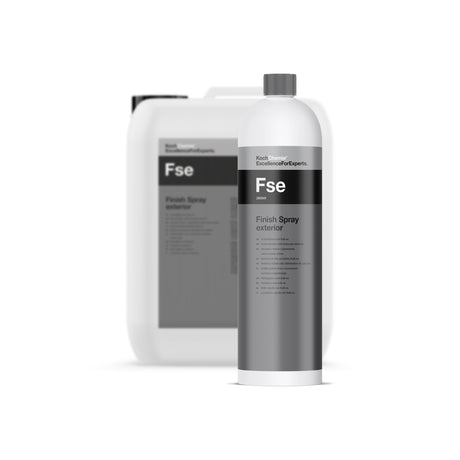
Stage three is the quick detailer as insurance against residual water. The Koch-Chemie Finish Spray Exterior FSE with integrated Kalk-EX binds mineral residues directly in the cloth, instead of leaving them on the paint. A field distribution across the roof, hood, trunk lid, and doors is sufficient.
The order is important. Wheels come first, because that's where brake dust works most aggressively. Then the roof, then the sides from top to bottom, finally the bumpers. Working from top to bottom prevents rinsed dirty water from running over already clean surfaces.

Which quick detailers and spray sealants work now
The most important helper in this weather situation is a quick detailer that simultaneously binds limescale and mineral residues. In our range, with the Koch-Chemie FSE Finish Spray Exterior, we have exactly the right tool. A liter bottle is enough for about 30 to 40 applications on a mid-range car, which lasts almost a year with weekly care.
If you don't already have a permanent quick detailer in your cupboard, the Quick Shine QS is a pH-neutral all-rounder, or the Quick Finish QF is the slightly more professional version with a high carnauba content. All three are in stock and suitable for the spring workflow. There are also dedicated water spot remover sprays on the market — but for fresh mineral residues, a normal quick detailer with a limescale active ingredient is usually sufficient, without having to resort to a more aggressive acid formulation.
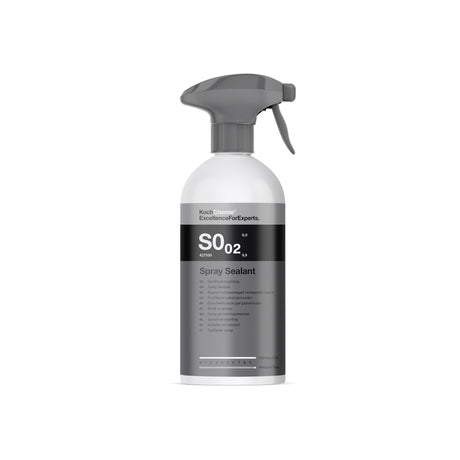
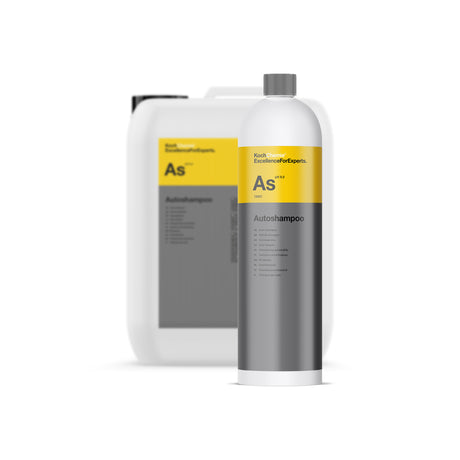
For pre-washing, the Gentle Snow Foam remains the first choice because it is deliberately pH-neutral and therefore does not attack wax or spray sealant layers. If you want to preserve the paint in the same work step, combine the wash with the Spray Sealant S0.02, which simply makes minerals bead off with the next rain.
For drying, the Pro Drying Towel with 950 GSM is worthwhile, because a denser towel absorbs the water droplets trapped between the minerals instead of just spreading them over the surface. If you're in a hurry, you can remove the water with the Quick Dry Shine QDS as a drying aid even before using the towel.
If you wash regularly, you can build a complete seasonal set from these components: Snow Foam for pre-wash, a neutral shampoo for the main course, Quick Detailer for quick refreshment, spray sealant for prevention. All four components together will carry a mid-range car through every spring and autumn phase for a whole year.
Common mistakes in the transition phase
The first mistake is waiting until Saturday morning. If you wait for the first real sunshine, you start too late. Minerals begin to crystallize even in diffuse daylight as soon as the outside temperature exceeds 15 degrees Celsius and the drops physically dry up.
The second mistake is wiping dry without washing first. If you wipe a cloth over the mineral-rich paint surface, you rub the abrasive particles directly into the clear coat finish and produce the fine wipe swirls that later return as holograms in sunlight. It's better to rinse once more than to tackle it dry once.
The third mistake is alkaline shampoo for spring washing. Highly alkaline cleaners do dissolve the pollen film faster, but they also remove any spray sealant or wax from last autumn. Pitfall: quick success, double work next weekend. pH-neutral care washes better during the transition phase.
The fourth mistake is the home remedy trap. If you try to remove stubborn water spots from car paint with vinegar, citric acid, or baking soda, you risk pH values between 2 and 3 directly on the clear coat. This dissolves the minerals, but it also attacks the upper clear coat layer. The spots are gone, and so is the gloss level. Detailing quick detailers work neutrally and precisely; that's the difference from home remedies.
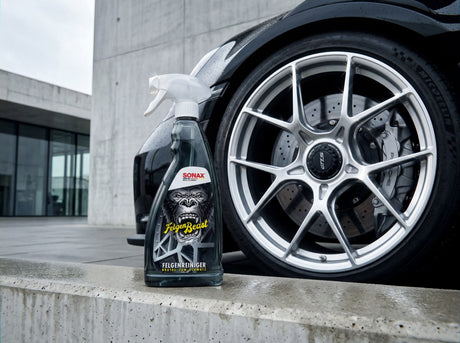
The fifth mistake concerns the wheels. The same mineral residue collects on the wheel surface as on the paint, only combined with brake dust. If you only clean the wheels after the paint, you let the hot brake dust work for hours. Wheel cleaning comes first, with a cold wheel, before the sun triggers any reactions.
The sixth mistake is washing in direct sunlight. If you start at 19 degrees Celsius and sun on Saturday lunchtime, the snow foam will have dried in two minutes instead of being allowed to work for six minutes. Dried snow foam becomes a sticky layer that has to be washed off again. Washing in the shade or early in the day is not a style tip, but material protection.
The seventh mistake happens with high-pressure cleaners at too short a distance. With pollen and mineral film, it's tempting to go at it with full nozzle power. However, this accelerates the friction of the dissolved particles and can damage the paint in sensitive areas. A minimum distance of 30 cm, fan nozzle, is the workshop rule.

Preventing water spots — what to do before the next rain
Spray sealants like the Koch-Chemie Spray Sealant S0.02 create a hydrophobic layer on which rainwater beads off instead of evaporating. Minerals are carried away with the running drops, not left behind in rings. A single application lasts between six and twelve weeks depending on the weather, rather at the lower end in spring, longer in summer.
If you plan a lead-in day once per season, for example at the beginning of April and once in September, you prevent most of these water spot episodes. The effort is about two hours per car, and the effect lasts throughout the entire quarter. From a workshop perspective, this investment is significantly more worthwhile than any subsequent polishing.
The second preventative measure is storage after rain. A carport or a shady garage entrance gives the drops time to evaporate undisturbed, without the sun building up drying pressure. If you don't have a roof, cover the car with a breathable cover as soon as it is certain that no further rain will come.
It is also important to check the pollen filter in the interior now. What lands on the paint outside also collects in the ventilation system inside. A full pollen filter reduces the interior climate and ensures that the car smells musty long after the last pollen flight. The rule of thumb for changing is every 12 months or 15,000 kilometers.
The third measure is a weekly visual inspection of the paint. If you look at the paint once a week in shallow sunlight, you will recognize developing water spot shadows before they set. A quick detailer is sufficient in the early phase. If you do this for a year, you will get through the season without any polishing work.
If you take all this into account, you will enter the summer months with paint that has withstood three to four spring rain fronts without visible traces. The investment consists of about two hours of lead-in care in April, a spray sealant in the drawer, and a quick detailer on the workbench trolley. The payoff is a car that looks like it just came from the workshop in any parking lot.
Detailing1-Insight: In the last four days, we've had almost 30 millimeters of rain, after four days of pure sunshine with pollen. The pollen-mineral mixture that is now on the car bodies is the trickiest thing we see in the workshop between mid-April and mid-May. If you run a snow foam on Friday evening or Saturday morning and follow it with a quick detailer, you get back the full effect of the spring season. If you wait until the first real sunny day on Sunday, you'll be working on dull shadow rings two weekends later that a normal detailer can no longer remove.

No time for the whole post? Get it summarized: