

Tyre Dressing vs Rain: Spray, Gel or Coating, What Actually Stays on the Sidewall
Daniel von Detailing1 |


CarPro
"Ech2O" Waterless-Wash Quick-Detailer
Waterless High Gloss and Protection
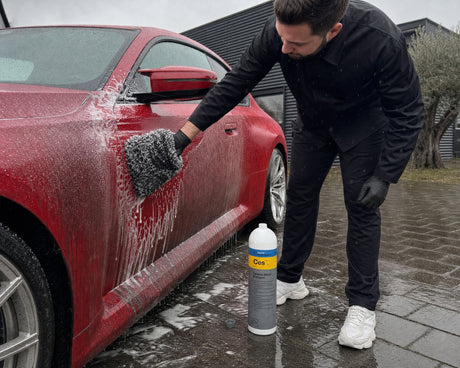
Koch-Chemie × THE FINISHER
THE FINISHER "MagicShampoo" Care Shampoo
Nourishing Shine Shampoo with Sealing Effect



INNOVACAR
"SP1" Prewash Pre-Wash Car Shampoo
Effective Pre-Wash Shampoo for Thorough Car Care
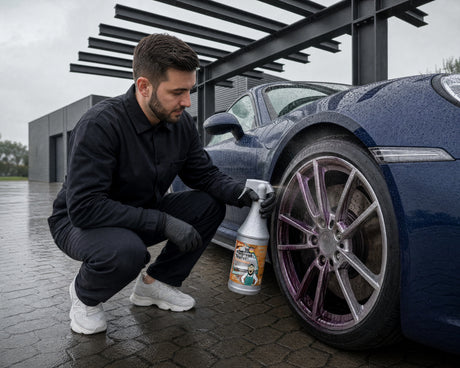
Embedded iron particles only dissolve visibly with a fallout remover


GYEON
pH-neutral car shampoo for coatings and waxes

SONAX
XTREME Shampoo "2 in 1" Car Shampoo
Shampoo "2 in 1" — Car shampoo with integrated wax care
INNOVACAR
"S3" Rinseless Rinseless-Wash (Washing Without Rinsing)
Water-saving car wash without rinsing


INNOVACAR
"DS" Scale Anti-Limescale Car Shampoo
Effective Anti-Limescale Car Shampoo for Perfect Vehicle Care


CarPro
CarPro "Reset" Intensive Car Shampoo
Highly concentrated car shampoo for paint coatings


INNOVACAR
"S1" Wash&Coat Car Shampoo with SiO2 Sealant
Shampoo with cleaning and SiO₂ protection in one step


Meguiars
GOLD CLASS Car Wash Shampoo & Conditioner Car Shampoo
Car shampoo for a perfect finish

SONAX
XTREME FoamGiant Shampoo Car Shampoo
FoamGiant — pH-neutral, gigantic foam carpet, film-safe


CarPro
"Descale" Acidic Car Shampoo Anti-Limescale Car Shampoo
Effective Acidic Car Shampoo for Limescale and Dirt
What makes a car shampoo good? Not how hard it cleans, but how well it slips. It lays a film between the wash mitt and the paint, so the mitt glides instead of dragging. That's exactly where a wash either leaves swirls or doesn't. At Detailing1 you've got 61 shampoos to pick from, from pH-neutral all the way to a care shampoo with a sealant boost.
Car shampoo is a surfactant-based concentrate for hand washing that does three jobs at once: it lifts the leftover film of grime, it holds the loosened dirt in suspension so it doesn't drop back onto the paint, and it lays a slip film between the wash mitt and the surface. The third job is the one that matters most, because it's what decides the state of your paint years down the line.
Day-to-day from Detailing1: What we see day-to-day is that overdosing is the most common mistake with car shampoo, and it feels right: more suds look like more cleaning. In reality a higher concentration barely improves the slip, but it leaves surfactant residue that dries into streaks and eats through your sealant faster. Stick to the maker's ratio and measure the concentrate out, instead of eyeballing it into the bucket. If you want more foam, fill the bucket with the water jet from up high — that whips up the same amount of shampoo far more.
A car shampoo is chemically simple, and more precisely tuned than the price tag suggests. Three things happen at once.
The first is lifting. Surfactants latch onto the film of grime with their fat-loving end and onto the water with their water-loving end. That floats the film off the surface with no mechanical pressure needed. It's the same mechanism as any cleaner.
The second is holding it in suspension. The loosened dirt has to stay in the water until it gets rinsed away. If it drops back onto the paint first, it turns into sandpaper on your next pass with the mitt. Good shampoos carry dispersants for exactly that, keeping the particles apart.
The third is the lubrication, and that's the real difference from an all-purpose cleaner. The surfactant film drops the friction between mitt and paint far enough that the mitt glides instead of grabbing. For you that means: a grain of sand the mitt does pick up gets pushed across the panel instead of pressed into it.
That slip is also why dish soap has no business on a car. It's built to cut grease and gives you next to no slip film — on top of that it strips off any wax or sealant in a single pass.
A fourth point is about the foam, and it's overrated. A bucket full of suds looks like it's working, but it says little about the slip. Some formulas are deliberately low-foam and still lubricate brilliantly, others foam hard and dry on faster. Go by the feel under the mitt: if it glides easily the mix is right, if it drags you need more water or a better pre-wash.
The pH decides how kind the shampoo is to the protection on your paint. Neutral shampoos around pH 7 leave wax and ceramic coating untouched, alkaline ones clean harder and cost you durability. Both have their place — just not in the same routine.
The range sorts into three groups, and the choice comes down to the state of your paint.
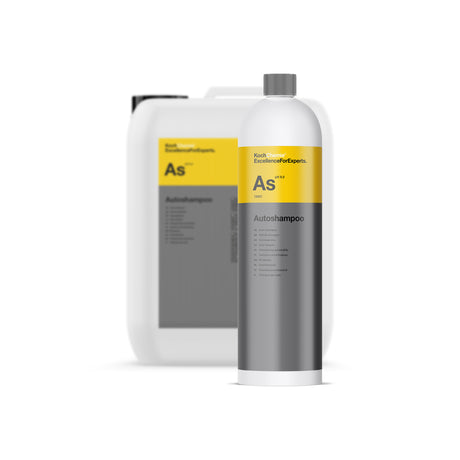
Neutral shampoos are the default for a well-kept car. They clean gently, slip well and leave any protective layer alone. For a sealed car on a weekly wash that's the right call, since all you're taking off is a light film of road grime anyway.
Care shampoos bring wax or polymer content along and top up a thin layer of protection with every wash. The Koch-Chemie Ceramic Effect Shampoo „Ces" Pflegeshampoo mit Versiegelung sits in this group, as does the Koch-Chemie Glanzwachsshampoo „Gw" Autoshampoo mit Versiegelung. The layer they build up is no substitute for a real sealant, but it keeps the beading going noticeably longer between two proper coats.
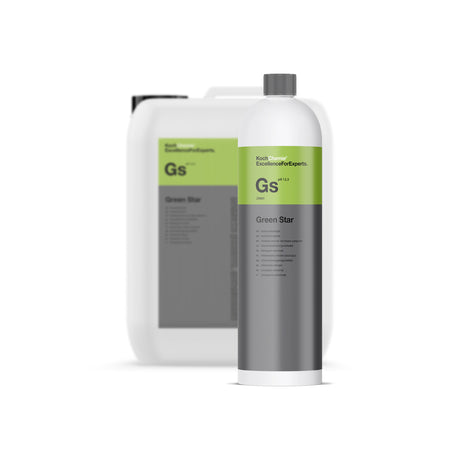
Active shampoos are the strong option with an alkaline share. They come out when the road film sits tight and the pre-wash didn't cut it. The Koch-Chemie Aktivwäsche „Aw" Aktiv-Shampoo is built for that and has no place in the weekly routine of a coated car.
A fourth group falls outside the grid: washing without rinsing. The Koch-Chemie Rapid Rinseless Wash „Rrw" Waschen ohne Abspülen is meant for lightly soiled cars where there's no water hookup. On heavily soiled paint the method is a poor fit, because the dirt never gets rinsed away.
The GYEON Q²M Bathe Autoshampoo and the TUGA Chemie Shampoo-Teufel® Autoshampoo cover the neutral group with a different signature — both lean heavily on foam while keeping the cleaning gentle.
Car shampoos are sold almost always as a concentrate, and the dosing is where most of it goes wrong.
The usual dilution runs between 1:100 and 1:400, depending on the product. On a ten-litre bucket that's somewhere between 25 and 100 millilitres, depending on the label. It looks like little and it's plenty, because the slip maxes out at a low concentration already.
Past that point more concentrate buys you no better wash. What it buys you is residue: surfactants that stay on the surface after the rinse dry into streaks and pull dirt in with the next rain. You'll spot it mostly on dark paint in backlight.
Water hardness plays into it too. In hard-water areas calcium and magnesium ions bind up part of the surfactants and the foam comes out weaker. The answer to that isn't more shampoo, it's a more thorough rinse and quick drying, so the limescale never dries on in the first place.
A rough yardstick for how far it goes: at a mid-range dose one litre of concentrate gives you around 20 to 40 bucket fills. For a car on a weekly wash that lasts a full season and then some.
Mixed-up shampoo isn't for keeping. The solution is heavily diluted and that makes it a nice breeding ground — after a few days in the bucket it smells musty and carries germs onto your paint. Rinse the bucket after the wash, wash the mitt with it and store both dry.
The same shampoo can be used three ways, and each one has a different job.
The bucket is the standard way and the only one where the slip really comes into play. Measure the concentrate, fill with water under pressure from up high so it foams up, dunk the mitt. A second bucket of clean water to rinse the mitt halves the amount of dirt that finds its way back onto the paint.
The foam lance on the pressure washer is the second way and it often gets loaded with the wrong stuff. Car shampoo isn't built to dwell — the foam collapses within seconds and soaks nothing. That's what snow foam is for, which you'll find under foam & snow foam. Shampoo in the lance just burns through product for nothing.
The third way is the rinseless wash. Here the concentrate is mixed a lot weaker, wiped on with one cloth and pulled dry with a second. It works on lightly dusted cars and it's the worst option going on gritty paint, because no water flushes the particles away.
Water temperature matters less than most people think. Lukewarm water lifts grease a touch better, but hot water speeds up drying on the panel and with it the risk of water spots. In summer cooler water is the safer bet.
After the wash comes the rinse, top to bottom and generous. Shampoo residue in gaps, seal folds and around the trim runs out on your next drive and leaves streaks on a panel that was actually clean.
Our shampoo range is the widest we carry within car washing and covers every price and demand bracket.
SONAX tops the brand list, mostly in the ready-to-use and mid segment. If you'd rather work without measuring anything out, that's the obvious pick.
Koch-Chemie fields nine items but clearly leads on sales. The reason is the system behind it: for every state of paint there's a matching product, from the neutral standard shampoo through the care shampoo to the reactivation shampoo for ceramic coatings. Once you're in the system, you find the right step without switching brands.
GYEON, Meguiar's, CarPro and INNOVACAR round it out with three to six items each, leaning towards shampoos for coated cars. The SONAX XTREME Rich-Foam Shampoo Auto-Shampoo and the SONAX XTREME Ceramic Active-Shampoo Autoshampoo cover that ground on the SONAX side.
Two items in the range are rinseless products for use without water, plus there's a dedicated motorcycle shampoo. For two-wheelers the different formula matters, because there's a lot more bare and anodised metal on show than on a car.
On sticker price the spread is wide, on price per wash it's tight. A pricey concentrate at 1:400 can work out cheaper per bucket than a cheap one at 1:100 — a look at the recommended dilution pays off before you look at the bottle price.
Which shampoo fits comes down to the state of the paint — more precisely, what protection is sitting on it.
On a ceramic-coated car the choice is tightest. Alkaline shampoos cost durability, and the coating is the most expensive layer on the car. Neutral or reactivating shampoos belong in the routine here, and reaching for an active shampoo stays the exception.
On a waxed or sealed car the same holds, just softer. Wax is more delicate than a ceramic layer and washes off a bit more with every alkaline pass. A care shampoo with some wax in it holds the state here rather than wearing it down.
On an unprotected daily driver you've got a free hand, since there's nothing to strip. Here it's the slip that counts, and a neutral standard shampoo delivers it for the smallest money. If you want to protect the paint, you'll find the way in under paint sealant.
In winter the demand shifts. Road salt is an inorganic problem that surfactants only tackle so far — here a thorough rinse with plenty of water counts for more than the shampoo choice, especially in the wheel wells and folds. More important than the product is that the car gets washed at all — even at five degrees, and even if it's grey again two days later.
On a motorcycle and on vehicles with a lot of bare metal, it pays to check the formula. Strongly alkaline products attack aluminium and anodised surfaces, and the damage shows up as a dull stain you can't polish back out.
On a used car after a long spell parked up, shampoo isn't the tool for the job. Tree sap, tar spots and baked-on bug guts won't dissolve in any shampoo solution, however strong you mix it. These get spot-treated with dedicated products from cleaners before the actual wash begins — more pressure with the mitt only costs you clear coat.
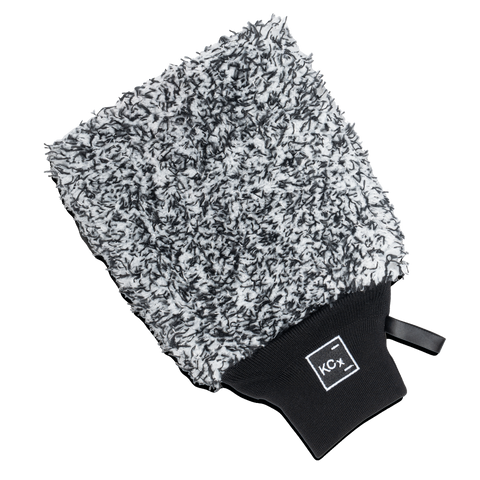
For the step before the hand wash, the way leads to foam & snow foam and pre-cleaners, and the full routine is laid out under car wash. Matching wash mitts and drying towels are under cloths.
Too much choice in Car shampoo? Get help picking:
Daniel von Detailing1 |

Daniel von Detailing1 |

Daniel von Detailing1 |

Daniel von Detailing1 |

Daniel von Detailing1 |

Daniel von Detailing1 |

Daniel von Detailing1 |

Daniel von Detailing1 |

Daniel von Detailing1 |

Daniel von Detailing1 |

Jasper von Detailing1 |

Daniel von Detailing1 |