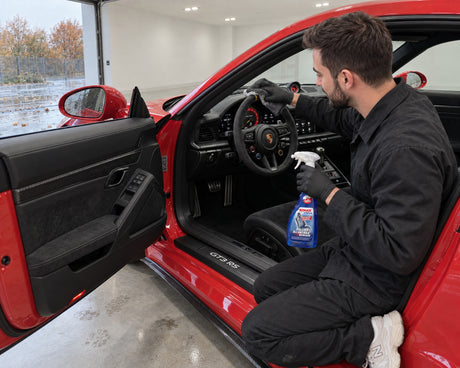
Cleaning an Alcantara steering wheel: grippy again, not greasy
Daniel von Detailing1 |


YETI
Bucket Utility Gear Belt / belt pouch for the "LoadOut® Bucket"
Perfect organization for your wash bucket
What are bucket bags? Bags that sit on the outside of your wash bucket and keep brushes, spray bottles and dry towels within reach while you wash the car. The water stays in the bucket, and the tools stay off the ground. Not a fashion bag, and not a tool bag for a builder's bucket.
Bucket bags are storage for hand-washing: a bucket bag is a belt with pockets that wraps around the outside of your wash bucket. At Detailing1, that's the YETI Bucket Utility Gear Belt / Gürteltasche für "LoadOut® Eimer", a bucket bag with four outer pockets for the 19-litre LoadOut bucket. It turns the bucket into a small work station: water inside, tools outside, both in one place next to the car.
Detailing1's tip from the shop: One rule from what we see day-to-day: never put brushes and towels down on the ground during the wash. Down there they pick up sand and grit, and the next time you grab them, it goes onto the paint. Stick them in the bag on the bucket instead. Anything that falls anyway doesn't go back into the pocket; it only goes back on the paint after it's been rinsed out.
At the wash bay, the bucket bag keeps two things apart that don't belong together: the wash water in the bucket and the dry tools you keep reaching for in between.
The term means two things. Search for bucket bag and you'll end up with woven handbags shaped like a bucket, or tool bags that slip over a 20-litre builder's bucket. Neither has anything to do with car care. This page is about the bag on the wash bucket that works alongside you while you wash the car.
At its heart is a separation that pays off in every hand wash. The water in the bucket is your working medium; the mitt dips in and takes wash solution to the paint. Everything else you need while washing doesn't belong in the water. A brush that falls into the bucket picks up the dirt that has settled at the bottom.
The bag solves that without changing the bucket. It sits on the outside of the bucket wall and takes up nothing inside, where the grit guard or washboard does its job. How to choose the bucket itself, with volume, material and setup, is on the Wash buckets page. This page starts where the bucket is already decided.
For beginners, it sounds like small stuff, and the first time you set it up, it feels that way too. Every part is still looking for its place, and you reach into the wrong pocket twice. That's part of it. After a few washes, the order sticks, and the bag becomes the thing you only notice when it's missing.
Tools have three possible places at the wash bay: on the outside of the wash bucket in the bag, inside below the rim in the caddy of a tool bucket, or separate from the bucket in a box.
The bucket bag is the place for everything you reach for several times during the wash. It hangs where the bucket stands, right next to the wheel or the door you're working on. You don't get up, you don't walk to the boot and you don't dig through a box; you just reach to the side of the bucket.
The caddy is an organiser insert that sits inside, just below the rim. The YETI Bucket Caddy / Einsatz für "LoadOut® Eimer" has 3 compartments for bottles and brushes and, according to the product details, can be combined with the lid. It's meant for a bucket that serves as a toolbox, not for the bucket with wash water. Which inserts work in the water is shown on the Bucket inserts page.
The box is the place for stock and transport: chemicals in full containers, spare towels, machines. It stays in the boot or on the shelf and doesn't come along to every wheel. If you want to transport chemicals and accessories safely, you'll find suitable crates under Storage boxes. The bag on the bucket doesn't replace a box; it just shortens the reach to the next tool.
Tool bags for builder's buckets follow a different logic. Some have pockets inside and out, because the builder's bucket itself serves as a toolbox and holds no water. On a wash bucket, inner pockets would be in the way, because the inside belongs to the wash solution. So a bucket bag for washing the car stays on the outside. Wash bucket organisers from US detailing retailers go for mesh pockets that dry quickly, because outer pockets catch splash water while you wash.
The decision follows your routine. If you carry one bucket to the car purely as a toolbox and mix the wash water in a second bucket, the caddy fits. If one and the same bucket has to carry water and tools, the tools go outside in the bag. And anything you don't need during the wash at all stays in the box.
What goes in the bucket bag is whatever you need dry and within reach during the wash: detailing brushes, small scrub brushes, folded towels and a handy spray bottle of cleaner.
YETI gives no pocket dimensions or material for the utility belt. So what goes in follows from your tools, not from a table. A detailing brush for badges and the grille, a wheel brush, 2 small dry towels for mirrors and door sills and a small spray bottle are the obvious loadout. The first setup will show whether your biggest bottle fits.
Large drying towels don't belong in the bag. They're too bulky for an outer pocket and should stay clean and dry until you use them, so in a pouch or in the box, away from splash water. Only the small towels you grab in between for mirrors, badges or door shuts go in the bag.
Wet microfibre doesn't belong in the bag for storage. A towel sitting damp in a closed pocket dries badly and starts to smell. The bag is a workspace for the duration of the wash, not storage for afterwards. So after the final rinse, everything comes out: wet towels into the laundry or out to dry, and the empty bag gets shaken out and dries open before the bucket goes back in the car.
Keep paint and wheels separate, in the bag too. A brush that has just pulled brake dust out of the spokes doesn't belong in the same pocket as the towel for the bonnet. Settle on a fixed layout, for example everything for wheels and tyres on the left, everything for paint and glass on the right. That way you won't grab the wrong tool by accident.
Spray bottles deserve a second look. If the spray head has a closed position, turn it to closed before you put the bottle in. Otherwise, if the bottle hangs at an angle while you carry it, cleaner drips into the pocket and onto the towels next to it. A towel that has come into contact with wheel cleaner doesn't go back on the paint afterwards; it goes in the wash.
The benefit of a bucket bag shows at the wash bay: the tools travel around the car with the bucket and don't end up on the tarmac during breaks.
Without a bag, the brush lies on the ground, on the bucket rim or on the car's roof. All three are bad places. On the ground it collects sand, on the rim it falls into the water, on the roof it leaves marks or slides off. The bag gives it a place that moves with you.
Position the bucket so the pocket with the tools for the side you're working on faces you. When you switch to the other side, take the bucket by the handle and the tools come along without a second trip. Our guide to the Zwei-Eimer-Methode explains how the two-bucket wash works as a process.
It pays off most when you wash in different places. If you wash at a self-service wash bay, as long as the site rules allow bucket washing there, or sometimes in the driveway and sometimes in the yard, you don't have a shelf next to you. Then the bucket is your mobile station, and the bag replaces the shelf that isn't there. That said, many self-service wash bay operators ban bucket washing completely, for example because of how long you'd occupy the bay or because the oil separator can't cope with heavily foaming third-party products. So check the bay's rules beforehand.
Pack the bag before the wash, not halfway through. Once the mitt is wet, you won't want to go digging in the boot for the brush. A fixed routine helps: fill the bucket, load the bag, put the bucket by the first side, and only then start. If you do the wheels first with their own bucket and their own tools, the bag only holds tools for paint and glass afterwards, and the brake dust stays with the wheel bucket.
The YETI utility belt is built for the LoadOut bucket and belongs to a system of bucket, lid, seat lid and caddy, all of which assume the same bucket shape.
The matching bucket is the YETI LoadOut® Bucket / 19 Liter Eimer. On top of it sits the YETI Bucket Lid / Deckel für "LoadOut® Eimer" or the YETI Bucket Swivel Seat / Sitzdeckel für "LoadOut® Eimer". The utility belt hangs on the outside. The caddy can sit inside when the bucket serves as a toolbox and the wash water is in a second bucket.
The HitchPoint webbing is a row of MOLLE-style loops. MOLLE is an attachment system in which accessories are threaded through horizontally stitched webbing. For you, that means you can attach small YETI add-ons such as a bottle opener without them taking up room in a pocket. For washing, that's a bonus, not a reason to buy.
There's no evidence that the utility belt holds on other buckets. YETI offers it explicitly for the LoadOut bucket and gives no dimensions for other buckets. Even within the brand, add-ons aren't freely interchangeable; YETI, for example, lists a drinks bucket lid as not compatible with the LoadOut bucket. You'll find all the YETI parts for the bucket collected under YETI Bucket accessories.
When you're getting into the system, the order we recommend in our advice is: bucket and lid first, then, after your first few washes, the add-on you actually find yourself missing. If you often work at knee height on wheels and sills, the seat lid is the likelier pick. If you're constantly hunting for brushes and towels, go for the utility belt. That way you buy what you need, not what's in the catalogue.
A bucket bag doesn't prevent scratches; it only stops tools ending up on the ground. If you already have a fixed wash spot with a shelf, you don't need one.
Swirls, the fine circular scratches in the paint, come down to the pre-wash, a clean wash mitt, a grit guard in the rinse bucket and calm movements. The bag doesn't directly improve any of these. It just takes away one chance to drag dirt in. If your budget is tight, put it into the bucket, grit guard and mitt first and add the bag later.
It's worth it if you wash on the move, if your wash spot changes, or if you're already working with the LoadOut bucket. It's less worth it if you wash at a fixed spot with a workbench, wall shelf and hose holder. There, everything already sits up off the ground and clean; the bag just moves it somewhere else.
For pure function, less is often enough. If you wash once a month outside your own front door, put brushes and towels on a clean, raised surface, such as an upturned second bucket with a lid or a folding stool. The bucket bag just makes it more convenient, because the shelf travels with the bucket.
Without a LoadOut bucket, there's no evidence the utility belt fits. In that case, stick with a raised, clean surface next to the bucket. If you're completing the bucket first, the Bucket lids page shows which lid goes with which bucket, with everything else in the overview under Wash buckets & accessories. If you have the YETI bucket, the bag brings a quiet side benefit: what hangs on the outside doesn't fall into the water, and the wash water stays free of brushes slipping in off the rim.
Too much choice in Bucket bags? Get help picking:
Add Detailing1 as a preferred source on GoogleA bucket organizer is a pouch that attaches to the outside of a wash bucket, keeping car wash tools within reach. At Detailing1, this includes the YETI LoadOut Utility Gear Belt with four exterior pockets for the 19-liter LoadOut bucket. It has nothing to do with bucket-shaped handbags or tool pouches for construction buckets.
The fit is only verified for the 19-liter YETI LoadOut Bucket, for which YETI offers the utility belt. The manufacturer does not specify dimensions for other buckets, and even within the YETI range, accessories are not universally interchangeable. Therefore, we do not recommend the pouch for buckets from other manufacturers without test-fitting first.
Anything you need to keep dry and reach for frequently while washing: brushes, small scrubbing tools, small towels for mirrors and emblems, and a handy spray bottle with a closed nozzle. Wet microfiber towels for storage and large drying towels do not belong in there. Store tools for rims and paint in separate compartments.
On the YETI LoadOut Bucket, the components are designed for different positions: the lid or seat lid on top, the Caddy inside under the rim, and the utility belt on the outside wall. According to product specifications, the Caddy can be combined with the lid. With the Caddy, the bucket serves as a tool box; use a second bucket for wash water.
A bucket organizer hangs on the bucket and stays with you during the wash, keeping tools ready for the next few minutes of work. A detailing bag is a standalone carrying case for accessories that you take to the car and set down. One shortens travel distances at the wash station, the other organizes transportation. The two are not mutually exclusive.
At a fixed location with a shelf or workbench, it is less necessary because you already have a raised, clean surface available. The only important thing is that nothing is lying on the ground. The pouch pays off primarily if you wash on the go, at changing locations, or if you are already using the YETI LoadOut Bucket.
Daniel von Detailing1 |

Daniel von Detailing1 |

Daniel von Detailing1 |

Daniel von Detailing1 |

Daniel von Detailing1 |

Daniel von Detailing1 |

Daniel von Detailing1 |

Daniel von Detailing1 |

Daniel von Detailing1 |

Daniel von Detailing1 |

Daniel von Detailing1 |

Daniel von Detailing1 |