Removing limescale spots from car windows without scratching the glass
Daniel von Detailing1 |


Dr. Wack "S100"
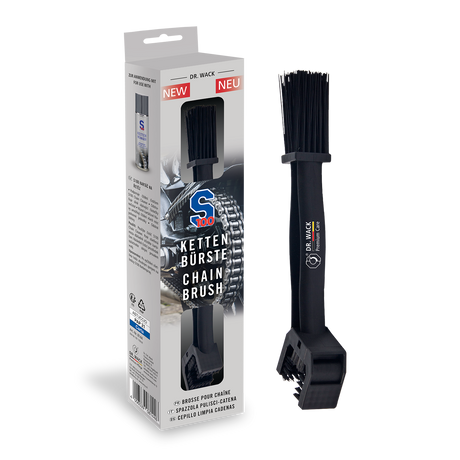
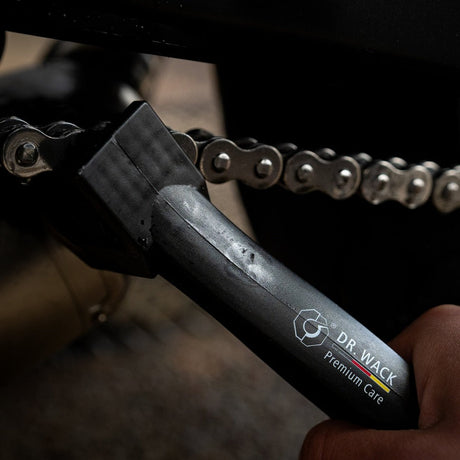
"S100" chain brush for motorcycles (for chain cleaner)
Effective Cleaning Brush for Dirty Motorcycle Chains
Dr. Wack "S100"
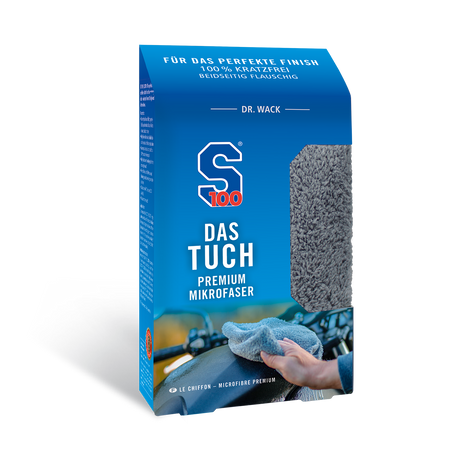
"S100" DAS TUCH microfibre cloth for motorcycles
Reliable microfiber cloth for a perfect finish and gentle polishing
What are the S100 accessories from Dr. Wack? The four helpers you use to apply and remove S100 motorcycle care cleanly: the cloth, the sponge, the wash mitt and a pressure sprayer for spraying on cleaners. Tools matched to the mixed materials on a motorcycle.
Microfibre Cloths & Accessories by Dr. Wack "S100" are the tools that shape the result on a bike just as much as the cleaner itself: a tightly woven cloth made of split polyester-polyamide fibre that soaks up dirt and water by capillary action, plus a sponge, wash mitt and pressure sprayer. Dr. Wack offers these four helpers in the S100 line from Ingolstadt — the first complete care line for motorcycles built around mixed materials: metal, plastic, rubber and paint. The thinking behind it: a motorcycle has tight angles and delicate surfaces where a rough rag does more harm than good.
Detailing1's tip from the shop: We often see fine scratches on the tank and side panels that come from the cloth, not the cleaner. The cause is almost always a cloth that was used on the wheels or chain first — the trapped brake dust and chain grease then act like sandpaper. Set up a clear system: one cloth only for painted surfaces and visible parts, a second for wheels, chain and engine. And wash your microfibre without fabric softener at a maximum of 60 °C, because softener gums up the fibres and kills the absorbency.
On a motorcycle, it's not just what you put on that counts, but what you put it on with. The right cloth and the right sponge contribute just as much to the result as the cleaner or quick wax in the bottle.
The reason is how bikes are built. A bike isn't a smooth sheet of metal but a cluster of material changes in a tiny space: painted tank, matte-black plastic fairing, polished aluminium fork, chromed exhaust parts, rubber seals. Each of these surfaces reacts differently to mechanical friction. A rough rag that works fine on the tank leaves fine marring on polished metal and can create shiny patches on matte plastic that never go away. Good microfibre draws dirt and water deep between the split fibres by capillary action and doesn't drag the particles across the delicate surface.
The S100 accessories are designed with this mix of materials in mind. The pressure sprayer gets diluted cleaner or water where your hand and cloth can't reach — into the spokes, behind the fairing, onto the engine block. The wash mitt keeps hand and paint away from direct contact with coarse dirt. The sponge spreads care products on the larger, flat areas, and the cloth takes care of the streak-free wipe-off and buffing. Each step has its tool, because a motorcycle is far less forgiving than a big bonnet.
What a lot of people underestimate: keeping tools separate on a bike isn't dogma, it's protecting the material. Chain grease and brake dust are the biggest enemies of visible surfaces. If a shared cloth carries them onto the painted tank, they'll drag smears or fine scratches into the clear coat. That's why the rule is even stricter on a motorcycle than on a car: separate cloths for clean and dirty zones. Once you've got that logic, you'll see the matched S100 accessories not as a nice extra but as a fixed part of a clean result.
Four items make up the S100 accessories at Detailing1: a cloth, a sponge, a wash mitt and a pressure sprayer. They're not a range of interchangeable alternatives but building blocks for the individual steps of looking after a motorcycle.
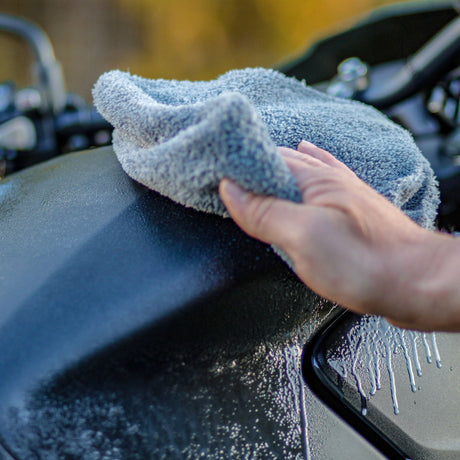
At the centre is "S100" DAS TUCH microfibre cloth — a microfibre cloth for motorcycles that removes cleaner residue, quick wax and water without streaks and buffs up the visible surfaces. On a bike, this cloth handles the last and most visible step: whatever's left on the tank after the wipe-off is what people see. That's exactly what the high fibre density is made for — it picks up rather than pushes.
S100 "DER SCHWAMM" wash sponge is the application and wash tool for the larger, easy-to-reach areas. Its structure spreads water and dissolved cleaner evenly across the tank, fairing and side covers. It complements the mitt, but it's meant for the flat sections where it works quickly over a wide area.
S100 "Der Waschhandschuh" microfibre wash mitt is the tool for the first step of every wash. Its long, soft microfibre pile picks up loosened dirt and carries it away from the surface instead of holding it at the contact point like a flat sponge does. It hugs the round, contoured shapes of a motorcycle better than a rigid sponge and reaches the transitions between parts too. Then there's S100 "Drucksprüher" pressure sprayer, which lets you put cleaner or water under pressure exactly where your hand can't go.
Choosing within the S100 accessories follows the job and the surface, not the price. Each of the four helpers has a property that suits it to a specific step of motorcycle care.
The microfibre cloth is the tool for all visible surfaces and the finish. Its pile height and fibre density decide how cleanly it removes cleaner and wax residue. On the painted tank and high-gloss parts, the rule is: only a clean, soft cloth, never the one that's just been on the chain or wheel. A second, clearly separate cloth takes care of the dirty zones such as the engine block and swingarm, where absorbency matters, not a mirror finish.
Sponge and mitt share the wash, but they have different strengths. The mitt is the lower-scratch choice for the round, contoured shapes and delicate visible surfaces, because its deep pile lifts sand and dirt upwards. The sponge comes into its own on the larger, flat areas, where it spreads quickly over a wide area. A sensible split: mitt for tank, fairing and anything curved; sponge for the wide, straight sections and for roughly pre-washing less delicate parts.
The pressure sprayer sits outside the cloth-and-sponge logic because it has a different job. It's not an application tool for panels; it pushes liquid under pressure deep into the bike — into the spokes, behind the fairing, onto hard-to-reach engine parts. With it, you apply diluted cleaner exactly where you want it, let it dwell and rinse off without tipping litres of water over the whole bike. Especially where no cloth fits, it's the helper that makes the difference between looking clean and actually being clean.
A thorough motorcycle wash with the S100 accessories takes around 30 to 60 minutes depending on how dirty the bike is, and always follows the same order: spray on and soak first, then wash, then dry and protect.
Step one is loosening the dirt with the pressure sprayer. Apply diluted cleaner evenly to the cold bike in the shade and let it dwell for a few minutes so bugs, road film and loose dirt come away — never on a hot engine or in full sun, because the cleaner dries too fast there and leaves streaks. Important: don't blast sensitive electrical contacts or the chain directly. This prep work takes the heavy friction out of the wash that follows.
Then comes the actual wash with mitt and sponge, ideally using the two-bucket method: one bucket with shampoo solution, a second with clean water for rinsing. Work from top to bottom, because the lower sections are the dirtiest, and rinse the mitt or sponge in the clean water after every pass so the dirt you've picked up doesn't go back onto the surface. Use the mitt for the round visible surfaces and the sponge for the wide sections.
Finally, drying and protecting with the microfibre cloth. Dry off the water with a clean, dry cloth before drops can etch in, and buff an S100 quick wax or care product to a streak-free finish with the second clean cloth. After the job, how you look after the accessories decides the next session: wash out the cloth, sponge and mitt, dry them separately, never put them on the floor, and wash the microfibre at a maximum of 60 degrees without fabric softener. Those 10 minutes of aftercare are the invisible part that secures the visible result next time.
In the market, the S100 accessories sit between the all-purpose rag from the DIY store shelf and the specialist detailing cloth brands. Their strength is predictability from a single source, matched to S100 motorcycle care; their limit starts where uncompromising specialist use begins.
Compared with all-purpose rags and terry towels, the advantage on a motorcycle is especially tangible: split microfibre picks up particles instead of pushing them over polished metal and paint, and the pressure sprayer reaches the tight angles of a bike that nobody can get to by hand. Made in Germany in Ingolstadt and a consistent range mean the cloth you buy today matches the fibre quality of the one you restock two seasons from now — something that's rarely true of no-name cloths from changing batches. If you already use the S100 line, the S100 accessories give you the right tools from the same house.
To be honest about the limit: for specialist paint correction with machine polishing and graded pad hardnesses, keen detailers reach for their own pad systems from specialist brands — that's not what a set of hand accessories is for. A dedicated XL drying towel will also clear large areas of water faster than a normal cloth. The S100 accessories are designed for looking after a motorcycle by hand, not for a machine-based detailing workflow. For exactly that use — regularly keeping a bike clean by hand while going easy on the materials — they're the right size for the job.
That positioning fits the brand as a whole. Dr. Wack stands for a solid mid-range you can rely on, and S100 is regarded as the first complete care line for motorcycles built around mixed materials. Its strength is breadth from a single source: if you use the S100 cleaners, chain sprays and waxes, the S100 accessories give you the matching tools. That's less flashy than a boutique cloth brand with specialist piles, but if you simply want to keep your motorcycle clean and cared for over the long term, that reliability is the real value.
If you're starting from scratch, the basic kit of wash mitt, one good cloth and the pressure sprayer is the right start. That covers loosening the dirt, the wash and the streak-free dry — the steps every motorcycle clean needs. Add the sponge once you regularly want to wash larger areas such as fairings quickly.
If you properly look after your bike rather than just hosing it down, a second cloth to keep clean and dirty zones apart pays off from day one. That split between a tank-and-visible-surfaces cloth and a chain-and-wheels cloth is exactly the step that takes your result from superficially clean to a scratch-free, well-kept motorcycle — no mixing, no particles dragged onto the paint. The pressure sprayer is the helper that makes the hard-to-reach areas reachable in the first place.
Both routes lead to the same goal: a motorcycle that gleams after a clean, without the fine scratches the wrong tools leave behind. If you want to go deeper into the line, the overview of Dr. Wack "S100" has the whole motorcycle line from washing and chain care to paint care, and under Dr. Wack you'll also find the car, wheel and glass ranges. The S100 accessories are the tool component in this system — rarely the hero of the story, but the part that decides between gloss and scratches on a bike. Once you've worked with the right microfibre cloth, mitt and pressure sprayer, you won't want to go back to an all-purpose rag.
Too much choice in Microfibre Cloths & Accessories by Dr. Wack "S100"? Get help picking:
Daniel von Detailing1 |

Daniel von Detailing1 |

Daniel von Detailing1 |

Daniel von Detailing1 |

Jasper von Detailing1 |

Daniel von Detailing1 |

Daniel von Detailing1 |

Daniel von Detailing1 |

Jasper von Detailing1 |

Jasper von Detailing1 |

Daniel von Detailing1 |

Daniel von Detailing1 |